


If you want a stable life, do medicine or banking
- Feb 6
- 4 min read
Updated: Feb 13
Interview with model and dancer Casper Tveteraas Hauge.
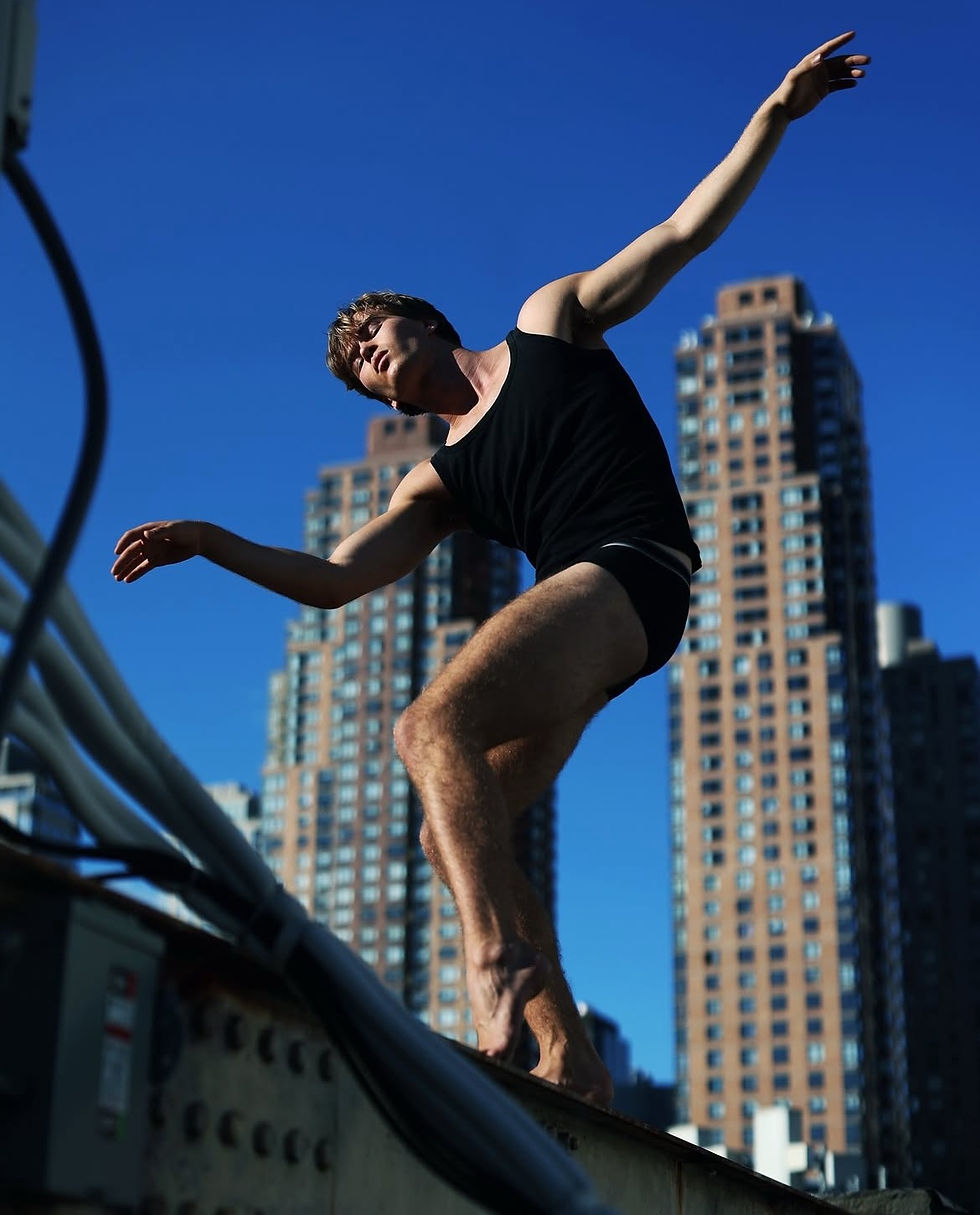
Casper Tveteraas Hauge arrives in London straight from the airport, with his suitcase still rolling behind him as we meet at the corner of Bedford Square. He looks relaxed. Traveling between countries is clearly just a normal part of his day. The 23-year-old from Stavanger moves between Norway, Paris, and London for work, balancing a bachelor’s degree in finance alongside modeling and dance jobs. When we sit down at Farmer J, he casually mentions that he’s in town for a secret Chanel shoot that won’t be released until October. Casper doesn’t seem stressed when I meet him. I ask if he ever gets tired, and he smiles. “No.”
Movement has always been part of his life. He started with gymnastics as a kid and trained professionally for years before slowly drifting toward dance, looking for something more creative. The athletic side transferred naturally, and dance gave him space to express it differently. He trained at The House of Dance in Sandnes (now called Core), where he grew up. A simple grey building that doesn’t say much from the outside, but where he spent hours shaping his unique style and technique.
After high school, Casper got accepted into engineering studies at NTNU, one of Norway’s most competitive science universities. On paper, it made sense. A solid education and safe future. But it didn’t take long before he realized it wasn’t for him. On a dare to himself, he applied to the National Academy of Contemporary Dance in Oslo, named KHIO. “I like challenges,” he says while laughing. Charming personality. He got in, but quickly felt restless. He started taking extra ballet classes at night, pushing himself beyond the school program, until teachers told him to stop because it wasn’t good for the mental health of his classmates. With a bitter voice, he says “I basically got in trouble for working too much. I absolutely hate that Norwegian kind of mentality where everything needs to be equal." He left not long after.
At twenty years old, he moved to Rotterdam to study at Codarts, one of Europe’s best dance schools. Getting in was even harder than KHIO, but he did. A year later, he landed a contract with Ballet National de Marseille in France, a company many of the dancers aim for after finishing at Codarts. He stayed there for a year, gaining experience, connections, and an understanding of the professional dance world. Which soon blended into modeling.
For most people, the idea of switching schools, countries, and career paths would feel risky. For Casper, it felt natural. He’s always known that dance and modeling won’t last forever, which is why he says yes to everything that comes his way right now. “I grew up with the mentality that people often regret the chances they didn’t take. I’ve heard it so many times. So I want to do everything and try everything, especially now that I can and have the opportunity,” he says.
At the same time, he gives the impression of being realistic about the business side of things, which is the reason he started studying finance part-time last fall. "I like having something practical alongside my creative work."
In Norway, modeling and contemporary dance are small industries with limited opportunities and lower pay. A photo shoot there might earn only one-fourth of what it would in London or Paris, and dance projects are harder to find. Abroad, modeling often pays well enough for him to live comfortably for six months, while dance remains more about passion. “Dance jobs pay almost nothing,” he says quietly while taking a sip of his coffee.
Casper's lifestyle is exciting, but it comes with its downsides. Traveling constantly makes it hard to build friendships. Most people he meets are through shoots and projects, and connections often stay surface-level through Instagram. Still, he makes an effort to stay close to friends in his class, calling them often while running between earens. “I think it is important to have friends outside the fashion and dance world as well” he highlights.
Later, I was excited to ask him about his craziest experience so far in the industry, as I have heard many rumors from our mutual friends. He told me that he once walked into a Kanye West party in Paris by simply dressing up and claiming he was on the guest list, which then led to an afterparty at Mbappé’s neighbor's apartment. However, on a more professional note, he says dancing on live TV along the Champs-Élysées in front of around 150,000 viewers remains one of his biggest moments. He keeps talking about big and small accomplishments, when he suddenly ends with "I do many fun things, tomorrow I will meet Gracie Abrams for coffee!"
After talking with Casper for an hour, I get the feeling that he doesn’t romanticize the industry even though he very much could. Breaking through as a male dancer and model, he says, takes full commitment and a high tolerance for uncertainty.
He tells me that he once asked an Oscar-nominated actor he worked with for advice about chasing such an unstable career, and her answer stuck with him: "If there’s something else you’d rather do, do that instead," he says. For Casper, there wasn’t. "If stability is your goal, do medicine or banking."
At this point, he opens up even more, explaining that at the beginning, he often worked for free, which he sees as part of breaking into the creative industries. Before I can ask whether he thinks that’s fair or not, he continues talking about how there’s rarely a steady paycheck, “and sometimes you get paid many months later,” no clear ladder to climb, and no guarantee that things will work out. Still, he believes it will. No surprise.
Casper believes that overthinking only holds people back. “When you start thinking about everything that could go wrong, you just make it harder for yourself,” he says. As we finish lunch and he heads off to his hotel room, Casper blends back into the noise of London.
Interview
1011 Words
i-D Magazine


Comments